The two questions that separate quality products from AI slop
AI makes building software easy, but quality still depends on two human questions: what do we build next, and how will it work? Here's how to answer both.
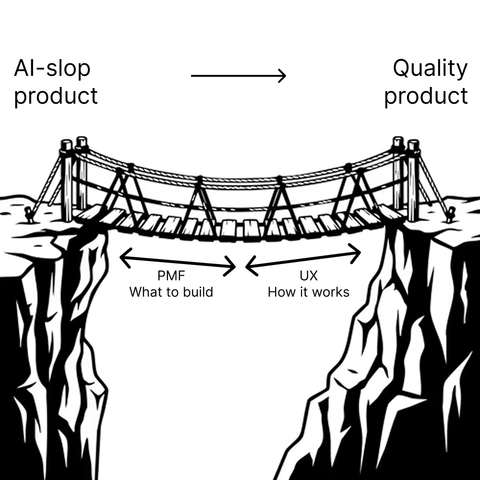
AI tools have made it possible for nearly anyone to build software products. However, the skills required to build a quality product are mostly unchanged, and necessarily human.
What good is a product with tons of features that nobody wants to use?
Or a product, with valuable features that nobody can figure out how to use?
In order to avoid building yet another AI-slop product, there are two simple, yet unexpectedly difficult questions that need to be answered well, and answered continuously:
- What do we build next?
- How will it work?
What to build
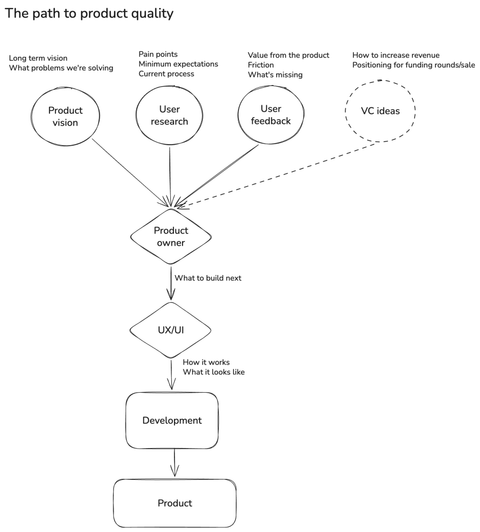
There are many sources of ideas for what to build. The most useful of these are:
- Founder / C-level product vision - This is the high level vision for what the product should achieve and the nature of the problems it’s intended to solve. It should also outline the product’s USP; how it will differentiate itself in the marketplace.
- User research - Talking to your potential customers provides insights into their biggest pain points, what they are looking for in a product, why current products fall short and, critically, a deep understanding of their goals and process.
- User feedback - Your current users will almost certainly request additional features and tweaks to make their lives easier. It’s also worth proactively connecting with them to better understand how they use your product and what would make it even more valuable to them.
- Investor ideas - If your company has investors, it’s likely they will contribute suggestions on features to open up new markets or to market the product to other investors or buyers.
There are other sources but they are mostly unhelpful, most notably, competitor products. Paying too much attention to what competitors are doing is a guaranteed way to create an unoriginal, second rate product.
Next comes the most important part; considering and combining ideas (dare I say ‘synergising’) from all of the above sources, in order to decide what to build next. As a simple rule-of-thumb, you should prioritise user feedback in the context of your founder’s vision in order to build features that will increase value to users while keeping the product within the overall vision.
In reality, to do this well, you need to continually refresh all 4 of the sources and consider how best to prioritise your roadmap in order to build a genuinely valuable product.
This job is typically done by the Product Owner, or in a small team, someone wearing the product owner hat. It’s a vital role in the pursuit of quality and requires a significant amount of gate-keeping in preventing the 4 sources above from directly influencing the development priorities. The more that happens, the more the product quality degrades over time.
How will it work?
Once we know what to build, we need to discover how it should work, from a user perspective (UX), and what it should look like (UI). How it should work is the most important part as your potential customers can only find value in your product if they can understand how to use it. The value it provides has to be greater than the friction of using the product, the price you charge and the onboarding effort.
More than any other part in this process, delivering quality UX requires significant skill that only a human can perform. AI tools can generate common UX patterns or help you weigh up competing options, however, to truly achieve a good result requires putting yourself in the shoes of your users, deeply understanding their process and goals and distilling complex steps into intuitive UI. UXers with these skills are rare and valuable.
In reality there will be occasions where UX/UI decisions are made by developers or articulated by the sources above e.g. CEOs, current users. If this happens rarely then it’s not an issue, however most product teams skip the UX step all or most of the time, and the product deteriorates over time.
Without a quality UX step defining the “how it works” for 99% of your product, you are guaranteed to end up with a Frankenstein-like mess, crushed under the weight of your UX debt.
Given that AI tooling has so massively sped up the coding process, allocating more time to the UX step is a massive opportunity, especially for smaller startups, to set your product apart from the pack.
One quick note on optimising this step for the AI era. There is a case for new features to be delivered using the existing UX patterns in your product, before a thorough UX solution has been completed, and having a UXer follow after with improvements to ensure UX quality.
Conclusion
The future of software belongs to the creators who believe in their product enough to pursue quality. Anyone can build software now, just the same as anyone can sing. Everyone should sing and most people should build software, but people only pay for good music, and they’ll only pay for quality software in the long term. Putting maximum effort into determining what to build and how it should work is the key to achieving that goal.
Comments